


Choosing the right fabric for flags
When it comes to choosing the best fabric for flags, there's no single right answer. It all hinges on what you need the flag to do and where it's going to live. If you're looking for something to fly day in, day out in a windy spot, woven polyester is the undisputed champion. But for a flag that needs to flutter beautifully in just a light breeze, nylon is your best bet. And for that classic, prestigious look indoors, you simply can't beat traditional cotton.
Your Quick Guide to Selecting Flag Fabric
A flag is far more than just a piece of cloth. It's a symbol, a statement, and often, a landmark. The material it's crafted from is the very foundation of its performance, dictating how it looks, how long it lasts, and how well it stands up to the job. Getting the fabric right means your investment will brave the elements, look its best, and represent its purpose with dignity.
Think of it like choosing the right coat for the weather. You wouldn't wear a light linen jacket in a snowstorm, would you? In the same way, you wouldn't fly a delicate cotton flag on a flagpole battered by coastal gales. Each material has its own unique blend of strength, weight, and visual appeal, making it suited to very specific environments.
Key Considerations at a Glance
Before we dive into the nitty-gritty, let's get to know the main players. Your choice will almost certainly come down to one of three primary materials, each with its own set of strengths:
- Woven Polyester: This is the workhorse of the flag world. It’s built like a tank for extreme durability in the harshest weather.
- Nylon: The versatile all-rounder. It offers a brilliant, lustrous appearance and has the knack for flying gracefully even in the lightest of winds.
- Cotton: The traditionalist's choice. It’s perfect for ceremonial duties and indoor displays where its rich, classic texture can be truly appreciated.
This guide will walk you through everything you need to know, from these core materials to the different weaves, weights, and specialist treatments available. To make that initial decision a bit easier, the table below gives you a quick, at-a-glance comparison to point you in the right direction.
Quick Comparison of Flag Fabrics
Use this table for a high-level comparison to quickly identify the best flag material for your specific needs.
| Fabric Type | Best Use Case | Wind Resistance | Colour Vibrancy | UV Resistance |
|---|---|---|---|---|
| Woven Polyester | Daily outdoor use in high-wind areas | Excellent | Good | Very Good |
| Nylon | General outdoor & indoor use | Good | Excellent | Good |
| Cotton | Ceremonial & indoor displays | Poor | Good | Poor |
As you can see, the ideal fabric is a trade-off between durability and appearance. Now, let's explore these materials in more detail to help you make the perfect choice.
Comparing the Top Flag Materials
Choosing the right fabric for flags isn't just about picking a material; it's about matching the flag to its environment. Think of it like choosing tyres for a car—what works on a smooth racetrack won't survive a rugged off-road trail. The big three in the flag world—polyester, nylon, and cotton—are each specialists in their own right.
Getting to grips with their strengths and weaknesses is the secret to a flag that not only looks brilliant but also holds its own against the elements. Let’s dive into these workhorse fabrics and see which one is the right fit for your job.
Woven Polyester: The Indestructible Workhorse
When you need a flag that simply will not quit, you turn to woven polyester. This is the heavyweight champion of flag materials, engineered to take a real beating from high winds, constant sun, and driving rain. It’s the go-to for situations where durability is non-negotiable.
Picture a flag flying high above a coastal landmark or on a skyscraper, exposed to the full force of the weather day in, day out. That's where woven polyester truly shines. It needs a bit more wind to get going, but its sheer toughness makes it the most economical choice for flags flown 24/7.
Key Takeaway: For maximum lifespan in punishing conditions, woven polyester is your best bet. Its incredible strength means fewer replacements and a flag that maintains its dignity for longer.
This fabric is also naturally resistant to UV rays, which means colours stay bold and true instead of fading out in the sun. If your number one priority is a flag that can endure the elements for as long as possible, this is where you start.
Nylon: The Vibrant All-Rounder
If woven polyester is a rugged Land Rover, nylon is a sleek sports car. It’s light, bright, and puts on a fantastic show. Nylon’s biggest claim to fame is its "flyability"—it's so lightweight that it catches the wind and flies beautifully in even the slightest breeze.
This makes it a superb all-rounder for everything from the flagpole in your garden to a corporate headquarters where you want the flag to be in constant, graceful motion.
What really makes nylon stand out, though, is how it handles colour. The fabric has a natural sheen that gives reds, whites, and blues a brilliant, almost luminous quality. It also sheds water like a duck's back and dries in a flash, helping to keep mildew at bay and maintain its light feel.
- Lustrous Finish: Nylon’s sheen gives colours a vibrant, eye-catching pop.
- Superior Flyability: Its light weight allows it to flutter in minimal wind, ensuring it's almost always on display.
- Quick-Drying: Resists water, making it a solid choice for rainy climates.
While it might not have the brute strength of heavy-duty polyester, a good quality nylon offers an unbeatable combination of durability and stunning looks. We explore the specific types of materials used for different applications in our guide to the fabric we use for our custom flags.
Cotton: The Traditionalist
Cotton is the material of history, ceremony, and tradition. For centuries, it was the only real choice for flags, and it still holds a special place for indoor displays, parades, and formal events. Nothing quite matches the rich texture and deep, matte finish of a classic cotton flag.
As a natural fibre, cotton just isn't built for the great outdoors. It soaks up moisture, making it heavy and prone to rot, and its colours will fade under relentless sun. The properties of natural fibres are quite distinct; for instance, understanding quilting cotton fabric gives you a good idea of how different weaves and weights behave.
But for an indoor flag in a grand hall, a ceremonial banner carried in a procession, or a flag used for a state occasion, the traditional elegance of cotton is second to none. It hangs with a weight and dignity that synthetics can't quite replicate, conveying a powerful sense of heritage and respect.
Understanding Fabric Weaves and Weights
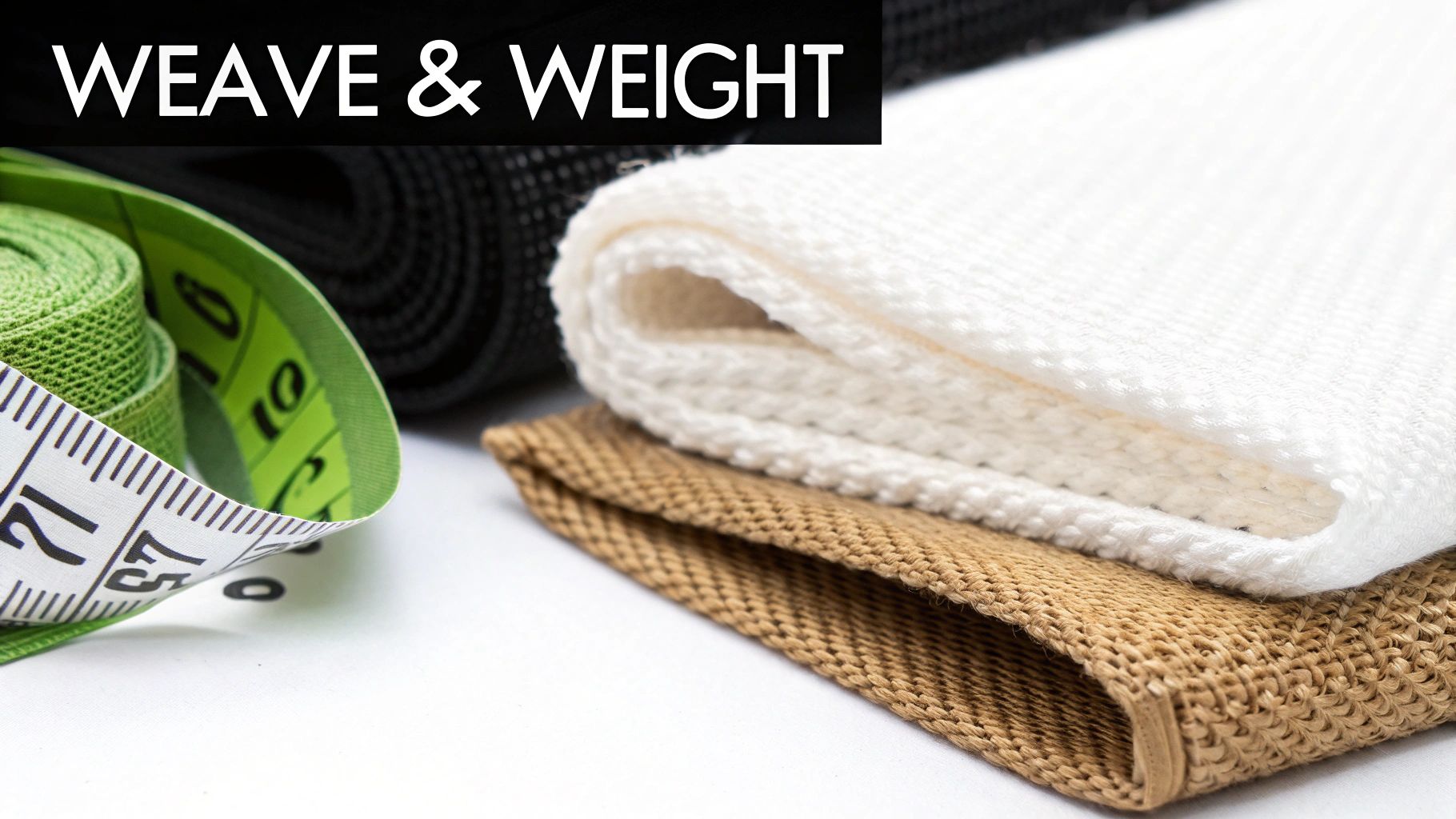
Choosing between polyester and nylon is just scratching the surface. To really get the right flag for the job, you need to understand how the fabric is put together—its weave—and how much it weighs. These details are what truly dictate how a flag will fly, look, and, most importantly, how long it will last.
Think about the difference between a tough pair of denim jeans and a stretchy football shirt. They're built for completely different jobs, and that comes down to their construction. Jeans are woven, giving them a rigid, hard-wearing structure. The shirt, however, is knitted, which makes it flexible and smooth. It’s the exact same principle with flags.
Woven Versus Knitted Fabrics
A woven fabric is made by crisscrossing threads at right angles, almost like weaving a basket. This locks the threads in place, creating a really strong, stable material that doesn't stretch much. For flags, this structure means serious durability. It’s why woven spun polyester is the go-to material for flags that are going to be battered by high winds day in, day out. It’s simply built to resist tearing.
Knitted fabric, on the other hand, is made from a single yarn that's looped together, a bit like a hand-knitted jumper. This gives the fabric a natural stretch and a much smoother face. That smooth surface is what makes knitted polyester the perfect canvas for detailed, digitally printed flags. You get crisp, vibrant images that just wouldn't look as sharp on a rougher woven material.
So, how do you choose? Here’s a quick way to think about it:
- Woven Fabrics: Think strength and tradition. They are the most durable choice for tough outdoor spots and have a classic, substantial feel that's perfect for sewn or appliquéd designs.
- Knitted Fabrics: Think visuals and performance. They offer brilliant colour for printing and are light enough to catch even a gentle breeze, making them ideal for promotional banners or event displays.
At its core, the choice is simple: woven for endurance, knitted for appearance.
Decoding Fabric Weight and Density
Once you start looking at specifications, you'll see terms like "GSM" and "denier". They might sound a bit technical, but they're incredibly useful for figuring out the quality and strength of a flag. Getting your head around them means you can read a product description and know exactly what you're buying.
GSM (Grams per Square Metre) is simply a measure of the fabric's weight. The higher the GSM number, the heavier and denser the material. A grand ceremonial flag, for example, will have a high GSM to give it a regal, weighty drape. A lightweight flag designed to flutter in the slightest breeze will have a much lower GSM.
A standard printed flag is often around 115gsm—light enough to fly well but still robust. At the other end of the scale, official Ministry of Defence-grade woven polyester is typically 155gsm or more, a clear sign of its heavy-duty construction.
Denier (D) is a bit different; it measures the thickness of the actual threads used to make the fabric. A higher denier means thicker, stronger fibres. So, a flag made from 200D nylon is going to be a lot tougher than one made from 70D nylon. This number is really important for large outdoor flags, where the sheer force of the wind demands the extra strength that thicker threads provide.
By looking at both GSM and denier, you get a complete picture. You move beyond just picking a material and start selecting a fabric that's been properly engineered for its purpose. It's this level of detail that ensures your flag isn't just a purchase, but a proper investment.
A Guide to Flag Weaves and Weights
Understanding how different weaves and weights affect a flag's performance is key to finding the right specification for your needs. This table breaks down the common options you'll encounter.
| Specification | Key Characteristics | Ideal Application | Common Example |
|---|---|---|---|
| 70-75D Woven Polyester | Very lightweight, economical, offers good print-through to the reverse side. | Short-term promotional events, giveaways, handheld flags. | Mass-produced national flags for sporting events. |
| 115gsm Knitted Polyester | The industry standard for printed flags. Smooth surface, excellent colour vibrancy, flies easily. | Digitally printed national flags, corporate flags, advertising banners. | A company flag flying outside an office building. |
| 155gsm+ Woven Spun Polyester | Extremely tough and durable, with a traditional matt finish. Resists fraying and tearing. | Exposed, high-wind locations, 24/7 flying, traditional sewn flags. | Ministry of Defence specification flags. |
| 200D Woven Nylon | Strong yet lightweight, with a bright sheen. Sheds water well and resists UV fading. | Premium outdoor flags, especially in wet climates. Popular in the USA. | High-quality US "Stars and Stripes" flag. |
Ultimately, matching the fabric's properties to the flag's intended environment is the secret to ensuring both a great appearance and a long life.
Exploring Speciality Fabrics and Protective Treatments
Choosing the right base material is a huge step, but the science behind a modern, high-performance fabric for flags doesn't stop there. Think of it like this: the base fabric is the foundation of a house. It's strong and absolutely essential, but it's the protective finishes—the roofing, the waterproof paint—that truly equip it to stand up to the elements year after year.
These specialist treatments and construction details are the unsung heroes of a flag's life. They provide crucial defences against specific threats, from the sun's relentless rays to the risk of fire in a public hall. Understanding these extras means you can specify a flag that isn't just fit for purpose, but actively engineered to last.
Guarding Against the Elements with Protective Coatings
Just as we put on sunscreen to protect our skin, flags need shielding from UV radiation. Without it, the vibrant reds, blues, and golds will inevitably wash out, fading into pale imitations of their former glory. This is especially true for flags flown in open, sun-drenched locations.
UV-resistant treatments are chemical coatings applied during manufacturing. They work by absorbing or reflecting harmful ultraviolet light, acting as a powerful barrier that preserves the integrity of the dye. Flags with this protection can maintain their brilliant colours for much longer. You can learn more about how a professional UV protection treatment can extend the life of your flag and keep it looking its best.
For marine environments, the challenges really multiply. Constant exposure to moisture and salt spray is incredibly tough on fabric fibres, encouraging mildew to take hold. It’s worth looking at how specialised waterproof boat fabric treatments work, as the same principles apply. These hydrophobic coatings make water bead up and roll right off, stopping the flag from getting saturated, heavy, and prone to rot.
Fire Retardancy for Public Safety
When a flag is displayed indoors—in a school hall, an exhibition centre, or any public building—safety becomes the top priority. Many public venues in the UK mandate that all hanging textiles, including flags and banners, must meet strict fire safety standards like BS 5867 Part 2 Type B or C.
A fire-retardant treatment is a chemical process that drastically slows the spread of flames. It doesn't make the fabric fireproof, but it ensures that if the material does catch light, it will self-extinguish once the flame source is removed. This is a critical safety feature that can prevent a small incident from escalating into a disaster.
Important Note: A standard polyester or nylon flag is not inherently fire-retardant. This is a specialist treatment that you must request when ordering to ensure your flag complies with public safety regulations.
The Critical Role of Reinforced Stitching
A flag’s greatest enemy is often the wind itself. The constant whipping and snapping puts immense stress on its edges, especially the "fly end"—the part furthest from the flagpole. This is always the first place a flag will show signs of wear and tear through fraying.
To fight back against this, quality flags use reinforced stitching. Here’s what you should be looking for:
- Double-Stitched Hems: All edges of the flag should be folded over and sewn with two parallel lines of stitching. This simple step prevents the edges from curling and beginning to fray.
- Quadruple-Stitched Fly End: The fly end demands extra reinforcement. Good manufacturers use four rows of lock stitching on this edge, which dramatically increases its resistance to shredding, even in high winds.
This careful attention to detail during construction is what separates a premium, long-lasting flag from one that will need replacing after just a few months. It’s a small detail that makes a world of difference in performance and long-term value.
Matching the Right Fabric to Your Needs
Getting to grips with the technical side of weaves, weights, and treatments is one thing. Now, let’s bring that knowledge into the real world and see how it helps you pick the perfect fabric for flags depending on what you need it to do. It’s all about translating the specs on paper into actual performance on the flagpole.
Think of it like a chef choosing the right knife for the job. You wouldn't use a delicate paring knife to chop through bone, and you wouldn't use a heavy-duty material designed for a ship's mast in a grand ceremonial hall. The secret to a flag that looks great and lasts is matching the fabric to its environment.
Everyday Outdoor Flags
If you’re after a flag to fly all year round from a flagpole at a home, school, or business, your top priority is durability. It’s got to stand up to sun, rain, and the constant stress of the wind.
For this kind of heavy lifting, woven spun polyester is the undisputed champion. Its tough, heavy-duty construction is designed from the ground up to resist the tearing and fraying that high winds cause over time. It takes a bit more of a breeze to get it flying, but that resilience makes it the most economical choice for a flag that’s up 24/7.
Ceremonial and Indoor Displays
When a flag is brought indoors or carried in a parade, its job changes. It's less about endurance and more about elegance. The look and feel of the fabric become the most important thing.
The rich, traditional texture of cotton gives it a classic, distinguished appearance that’s hard to beat, speaking of heritage and respect. For a more modern, lustrous look, a premium woven nylon offers a brilliant sheen that catches indoor lighting perfectly. Both fabrics drape beautifully, making them ideal for prestigious settings where the weather isn't an issue.
Expert Tip: For any flag displayed in an indoor public space, make sure it has a fire-retardant finish. This is often a legal requirement here in the UK and is a vital safety measure for schools, halls, and exhibition centres.
This simple decision tree shows how a flag's location is the first and most important factor in choosing protective treatments.
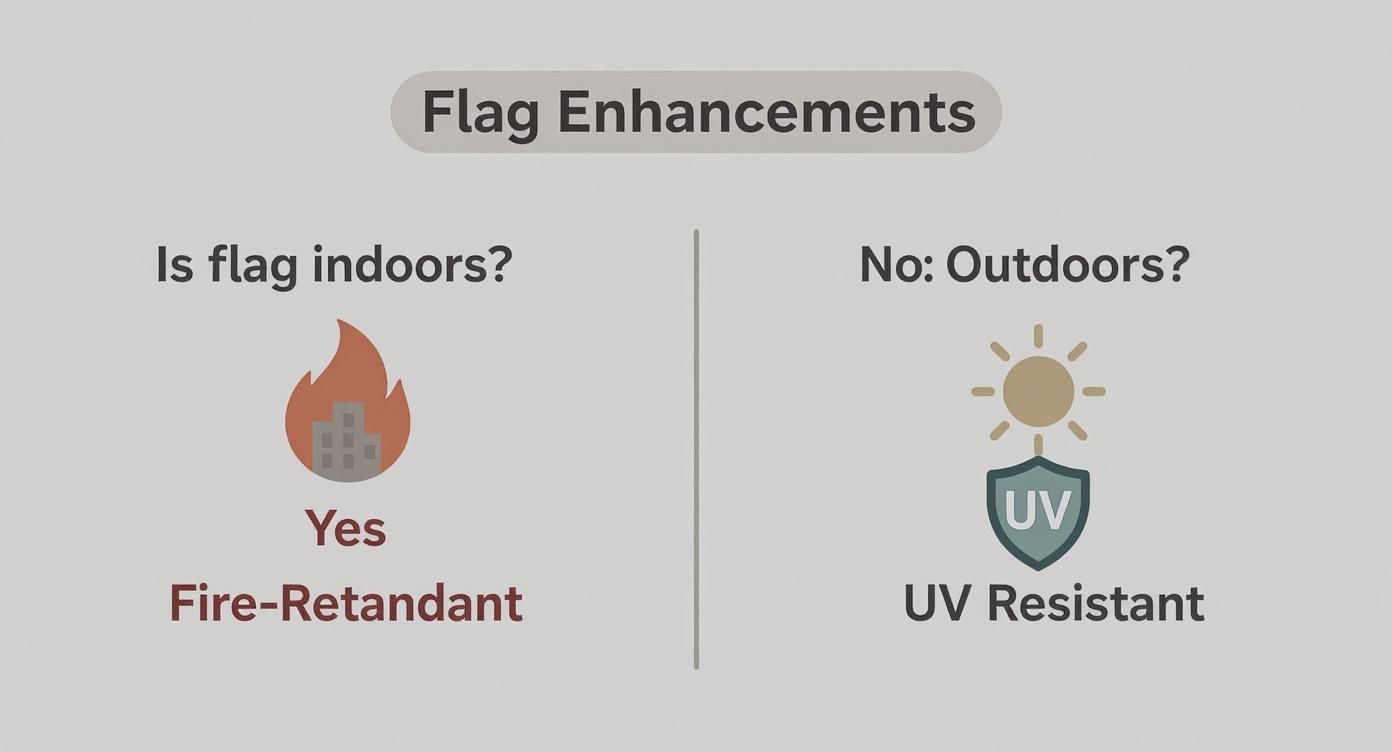
As you can see, the first question you should always ask is, "Where will the flag be used?" The answer points you directly to the key safety and durability features you'll need.
Digitally Printed Banners
When your flag needs to show off a complex logo, a detailed photo, or vibrant graphics, print quality is everything. The fabric has to be a flawless canvas that makes colours pop and keeps every line crisp and sharp.
This is where knitted polyester really shines. Its smooth, tight-knit surface is fantastic at holding ink, which means you get stunningly clear and vibrant images. It’s also very lightweight, making it a great choice for promotional banners and event flags that need to fly easily and grab people’s attention.
Marine and Boating Flags
The maritime environment is one of the toughest out there. A flag on a boat is constantly battered by high winds, corrosive salt spray, and moisture. This brutal combination can shred lesser materials in no time at all.
For such a punishing role, a specially treated nylon is the go-to solution. It has a great mix of strength and light weight, so it can fly proudly without putting too much strain on the mast. Crucially, it also dries quickly, so it won’t get heavy and waterlogged. Add in specialist coatings to fight off saltwater and UV damage, and you have the perfect material for life at sea.
The Evolution of Flag Materials
To really get a feel for the advanced fabric for flags we have at our fingertips today, it’s worth taking a quick look back at where it all started. Before synthetic materials were even a glimmer in a chemist’s eye, the choice of fabric came down to what was strong, available, and could survive a tough life, especially at sea.
In the early days of maritime flags, particularly here in the UK, they were made from a material called wool bunting. This was a coarse, hand-loomed textile, prized for its raw strength against brutal ocean winds and relentless salt spray. It wasn't exactly refined, but for its time, it was the best tool for the job.
From Hand Looms to Industrial Power
The path from those traditional textiles to the modern materials we use today is really a story of industrial innovation. Before mechanisation took hold, the quality of flag fabric was inconsistent, to say the least—a direct result of being woven by hand on traditional looms.
Early British flags from the 18th and early 19th centuries were almost all made from this wool bunting. It was a characteristically light and durable fabric, but it was also loosely and irregularly woven. It’s a fascinating detail that historians often use the uneven weave of these old flags to authenticate them. If you'd like to dive deeper, you can explore more about the history of flag fabric and see how production methods transformed over the centuries.
This image shows the Union Jack, a design that has evolved over centuries and has been made on many different materials, starting with traditional wool.
The crisp, geometric lines of the modern flag are a world away from those early versions, highlighting the need for stable, consistent fabrics that just weren't possible in the age of hand-loomed wool.
The Modern Materials Revolution
The Industrial Revolution was the big turning point. With mechanised production, wool bunting became far more consistent and regularly woven by the mid-to-late 19th century. This shift brought a whole new level of quality and uniformity to flag making.
But the real game-changer was the development of modern synthetic materials in the 20th century, like nylon and polyester. Their arrival completely shook up the industry.
These new fabrics offered a level of colourfastness, weather resistance, and lightweight strength that was simply unimaginable in the age of sail. They didn't just improve on the old materials; they completely redefined what a flag could be.
This journey—from natural, hand-worked fibres to scientifically engineered textiles—is precisely why we can now create flags that are brighter, stronger, and last longer than ever before, ready for any purpose we can imagine.
A Few Final Questions About Flag Fabrics
Even after diving into the details, you might still have a few practical questions. That’s completely normal. Choosing the right material can feel like a big decision, so let's tackle some of the most common queries we get.
Think of this as a quick-reference guide to help you iron out those last few details and choose your flag with total confidence.
What’s Genuinely the Most Durable Fabric for an Outdoor Flag?
If you need a flag that can handle being flown 24/7, especially in a windy spot, woven spun polyester is your best bet. It’s a real workhorse. This material is specifically constructed to take a beating from the elements, resisting tears and fraying much longer than anything else.
The trade-off is its weight – it needs a decent breeze to fly majestically, unlike lighter fabrics. But if your number one priority is longevity and you want to replace your flag as infrequently as possible, spun polyester is the undisputed champion for tough outdoor conditions.
How Should I Clean and Care for My Flag?
A little bit of care goes a long way in making your flag last. For most modern polyester and nylon flags, you can simply pop them in the washing machine on a gentle cycle with cold water and a mild detergent.
Crucial Care Tip: Whatever you do, don't put your flag in a tumble dryer. The intense heat can wreck the synthetic fibres and ruin it for good. Always let it air dry, either by hanging it up or laying it flat.
If you have a more delicate ceremonial flag or an older one made of cotton, play it safe and take it to a professional dry cleaner. Keeping it clean is important, as grime and pollutants can be surprisingly abrasive and wear down the fabric over time.
Why Did My Flag’s Colour Fade So Quickly?
The culprit behind premature fading is almost always the sun. Those powerful ultraviolet (UV) rays are relentless, and if a flag is made with cheap dyes, its vibrant colours can look washed-out in just a few months.
To avoid this disappointment, look for flags that are explicitly made with UV-resistant dyes and, for an extra layer of defence, a protective fabric treatment. This is non-negotiable for flags in sunny climates. While nylon starts off incredibly bright, a top-quality, UV-protected polyester will keep its colours looking rich and true for far longer.
What Does the Term ‘Denier’ Mean for Flag Fabric?
You’ll often see numbers like 70D or 200D mentioned. This is the 'denier', and it's simply a way of measuring the thickness of the threads used to make the fabric.
It's pretty straightforward: the higher the denier number, the thicker, heavier, and tougher the fabric. So, a 200D fabric is much more robust than a 70D one. When you’re choosing a flag for a really demanding job – like a massive flag on a tall, exposed pole – a higher denier is a great indicator of its strength and durability. It’s one of those key specs to check if you need a flag that's truly built to last.
At Flag Studio, we blend time-honoured craftsmanship with the best modern materials to create flags that don't just look good, but perform brilliantly. Whether you need a rugged woven polyester for the harshest weather or a vibrant knitted fabric for an eye-catching display, we have the expertise to find your perfect match. Explore our custom flag options and let us help you create a flag that stands the test of time.
Article created using Outrank
